

It should have been obvious to me that given my love for exploring bar culture when I travel, the UK would be a divine experience. But I always skipped it because it felt a little like traveling internationally to a place too similar to the US. Sometimes preconceived notions and misguided thinking can obscure good decision making. And sometimes I’m just dumb and wrong. So, I feel fortunate that a wedding forced me there this summer.
While there’s ease traveling in other English speaking countries, there’s still unending uniqueness that keeps it properly foreign. What I leaned into in the UK was not the wildest of contrasts, but it left its mark. The Brits have married two beautiful worlds — the dark seclusion of pubs serving low abv beer with the warm hug of Indian and Southeast Asian food. The why and how that came to be is layered with some ugly history, but the result is an absolute win. The United States needs to adopt this pairing. And fast.
Pub culture in the UK is in a class unto itself. Whether it was London, Newcastle, Edinburgh, or Glasgow, the pubs had great energy, both to relax with a pint at 1 p.m. or to get loud with the post-work crowd. Most are older than our infantile country, giving them an inherently communal vibe with decades more wear for that broken-in bar feel. They’re adorned classically – hanging plants rest outside windows, modest chandeliers and pendant lights drop from the ceilings, and along the edges, crown moldings mix in a little flare. But they mostly let the worn wooden bar tops, floorboards, and booths do the talking. The warmth they have is like an intrinsic trust. There’s comfort within those walls.
If Americans caution that nothing good happens after midnight, I think the British might say nothing good happens after 9 p.m. Nearly any bar I’d pass in the late morning or early afternoon would have some characters on display out front with a pint. There was no shame in this. The day drinkers might be football fans awaiting an early start, suits out to lunch, parents with a sleeping baby in a stroller, or an 80 year old reading a paper. Having a drink is part of the culture and celebrated.
There are many reasons, real or perceived, that might point to why Brits have a healthier relationship with alcohol and greater acceptance of it, but one was very evident for me: low ABV beer. America not only loves liquor, cocktails, and wine, but our craft beer scene is built on boozy beers, mostly IPAs. And while the craft beer scene is growing in the UK, the classic mid-strength beers still dominate. Cask Ales, Pilsners, Lagers, and Stouts are omnipresent. And they usually sit between 3-5%, that mid-strength range that Britain knows so well. Ain’t no one getting offended by someone taking the edge off with a 4% ale in the afternoon. That’s just Tuesday.
Drinking earlier with consistently low-ABV drinks means you can get your extended bar time in – socializing, detaching, relaxing, what have you – and wrap up a few hours before midnight. It’s a set up for success (Worth noting that I still managed to get pretty rocked a couple times abiding by this schedule). Outside of a few pubs with the draw of an excellent whiskey selection, I saw very few people swapping pints for anything else.
Now, if you make it to a pub with food, that’s when things get interesting. Sure, I enjoyed grabbing some traditional pub fare. I learned the simple satisfaction of a Toasty (basically a grilled cheese) served as a snack at select spots. The toasty’s service as a hold-over before mealtime was appreciated. And the proper meals of fish and chips or a meat pie with potatoes and peas tapped into some bygone farmer genes within me. Those are heavy meals though, and fairly bland, not something I crave multiple times in a week.
Enter the Southeast Asian and Desi Pubs of the UK, an experience that takes these already excellent pubs to a landmark tier of greatness. With the spices, heat, and variety of Asian food mixing with traditional beers, I felt as satisfied as I ever have at a bar. Bury my ass at the local pub that serves Anglo-Thai food, I’m perpetually content there.


After a 10 hour flight in which I only played with my airline meal (how and why do so many people devour that mockery of even the basic elements food?), it took another 90 minutes to get into the city and check into my hotel. But finally, I was free to explore and experience London, which inevitably begins with eating and drinking. I walked 20 minutes to a pub I’d already mapped out only to find out that they no longer served food. After a beer there, the same sequence repeated. The irritability and jetlag were setting in and the pressure mounted to find a good meal before I sabotaged my first night. I was 16 hours into a travel day with two drinks on board an empty stomach, the desperation was visceral. I never want to start a vacation off with a dispiriting meal, but I couldn’t wander aimlessly any longer, the next pub had to serve me my dinner.
I’d already walked by The White Hart, near the south end of Brick Lane, it seemed a little grungy and nondescript. They had some Jack the Ripper history noted outside the pub which made it feel gimmicky. But it was not a tourist trap and they had food. I was expecting traditional British pub fare but was handed a Thai menu. I knew London was known for its global food-scene but wasn’t expecting it at pubs. Certainly not this one. I looked around for a glimpse of someone else’s plate, but no one was eating, just a few people nursing pints. I felt the scales tipping towards my first tourist mistake — ordering food at a pub that locals never dine at. The bartender told me the kitchen was open but I’d have to order my beer and food separately, he’d get someone from the kitchen while I looked over the menu. When an older Thai woman came to take my order I immediately perked up. I ordered some version of a Pad Kra Pao dish.
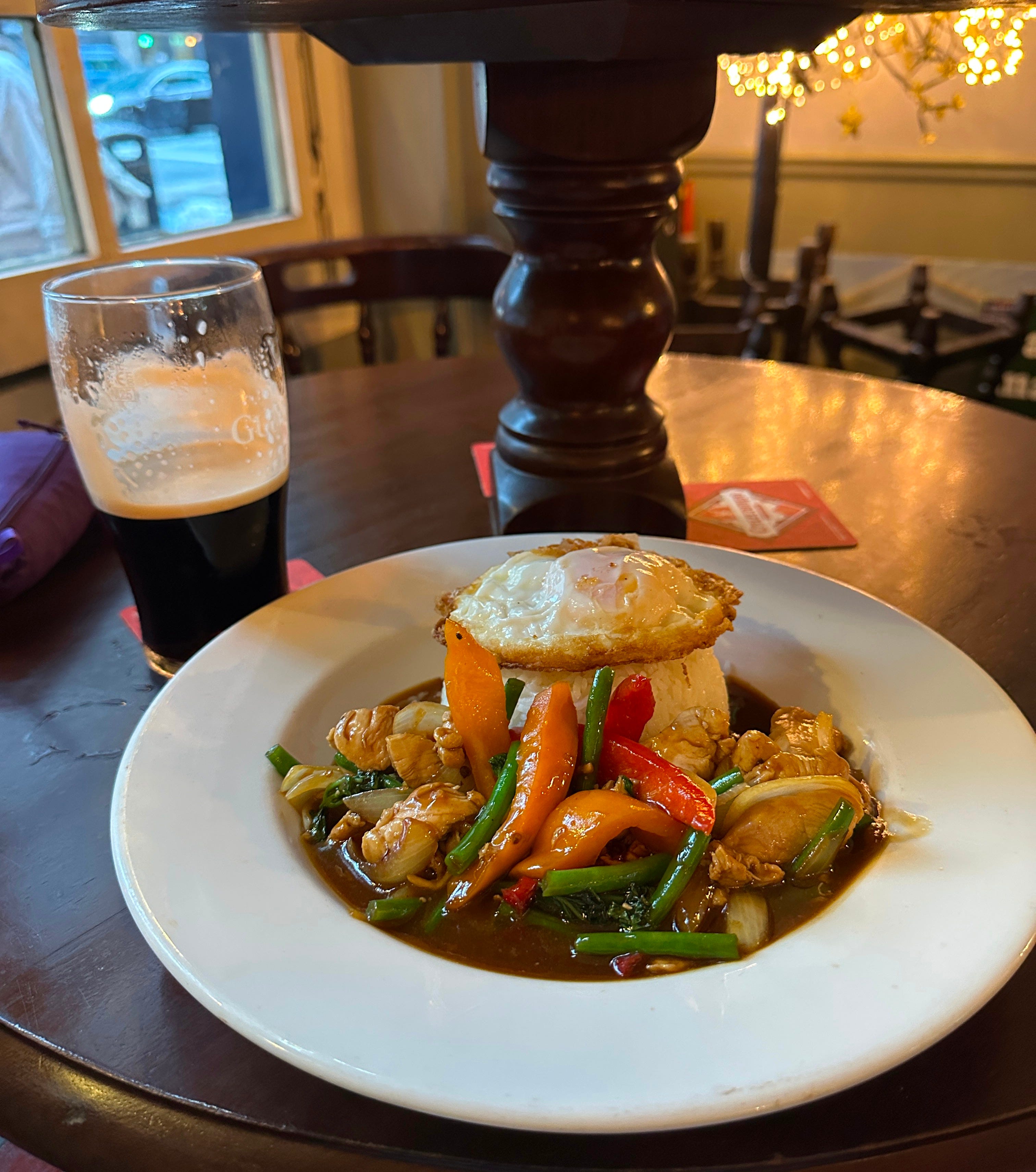
What came out what a steaming brown stew of vegetables and chicken, surrounding a symmetric dome of white rice. Perched on top was a perfectly fried egg. I was desperately hungry, but trust me, it was spicy divination. The peppers, onions, and green beans kept a slight crunch and freshness, the chicken was tender, and once cut, the egg yolk flowed slow, like honey. The sauce had good heat, but the basil and garlic shined through the richness. Say what you will, but the pillowy smoothness and mild bitter from my Guinness was a perfect counter to the spice of the Thai food. It was a harmony I hadn’t known existed. I was hooked and already thinking about my next Thai pub dinner.
Upon finishing, the man one stool down from me asked how my food was. I confirmed it exponentially exceeded my expectations. He said he only ever came by for a pint and never tried the food, but after seeing my plate it sounded like that was going to change. I encouraged him to do so. After this first meal, I started to see the crossover everywhere. This was not a unicorn of a pub but a celebrated adaptation. I ended up eating at the White Hart once more and a handful of other pubs with Asian menus. I was tempted to enter each one.
Though the origins of Southeast Asian and Desi Pubs happened separately, and a couple decades apart, neither was random luck. Desi Pubs have existed since the 60’s, the earliest report was in 1962. In pubs at this time, people of color were often served in different rooms than white people, or not welcome at all. Amidst this segregation, Indian landlords began to open pubs to offer an option to their compatriots. These Desi Pubs operated just like any other pub, but to make their patrons feel at home, they would serve Indian curries and grills rather than traditional fare (depending on where you look Desi means local, native, land, or country. In every case, fitting).
Despite the Race Relations Act of 1965, which outlawed discrimination in public places, many white landlords continued the practice of segregation. When licenses at these non-law abiding pubs went up for renewal, the Indian Worker’s Association would report them, and sometimes they’d lose their license. This allowed for those same Indian landlords to take over and create more Desi Pubs.
Desi Pubs provided diversification in these spaces and a safe, home-away-from-home for Indian immigrants. And it’s not home without the comfort food of the motherland. In turn, these safe havens introduced their food to a new, white audience – it was a revelation that saw Desi Pubs become a staple subset of London pub culture, and now throughout the UK. That’s the gist, but the full history of the Desi Pubs (and which are the best to visit) is worth diving into and it’s best told by the incomparable David Jesudason, a beer writer of the year winner and author of the book, “Desi Pubs.” (h/t All Things Are Quite Silent and Alex @ Pub Vignettes for steering me to him).
A few decades later, Anglo-Thai food began its own integration into UK pubs. This first began at the famous Churchill Arms back in 1988. A customer of the pub, who was a chef at a Thai restaurant, wanted to cook there and to start serving Thai food, and with some persistence he got a trial run. It was an immediate success and word spread.
While the Churchill Arms served as the blueprint, a larger, second push came at the start of the 21st century, thanks to the Thai government’s gastro-diplomacy campaign. If you’re not familiar, it’s exactly what it sounds like, a nation uses its cuisine to build its international presence and cross-cultural understanding, the goal being to increase tourism and economic growth. While this hit the US too, the pub integration happened in Britain. The success of the established Desi Pubs and the Churchill Arms likely helped the Thai campaign to take root in pubs, but an undeniable factor was simple economics.
We all know the service industry operates on razor thin margins, so if you’re looking to start a restaurant, but certainly if you’re doing so as an immigrant far from home, why open yourself to more economic risk than necessary? Who needs a whole brick and mortar space if you can take the under-or-un-used kitchen of a bar? Since much of the dishes are street food, a sprawling or well-designed kitchen isn’t needed. Having enough room for a few woks, spices, and fresh ingredients will likely suffice. The chef pays a fraction of what it would cost to lease their own space, and with a bar’s established clientele built-in, it’s an easy sell. Meanwhile, the bar owner gets help with their lease and a secondary element to draw in more customers. And of course, we the patrons, get a great meal at our favorite bar. It’s win-win-win. In this scenario, everyone eats.
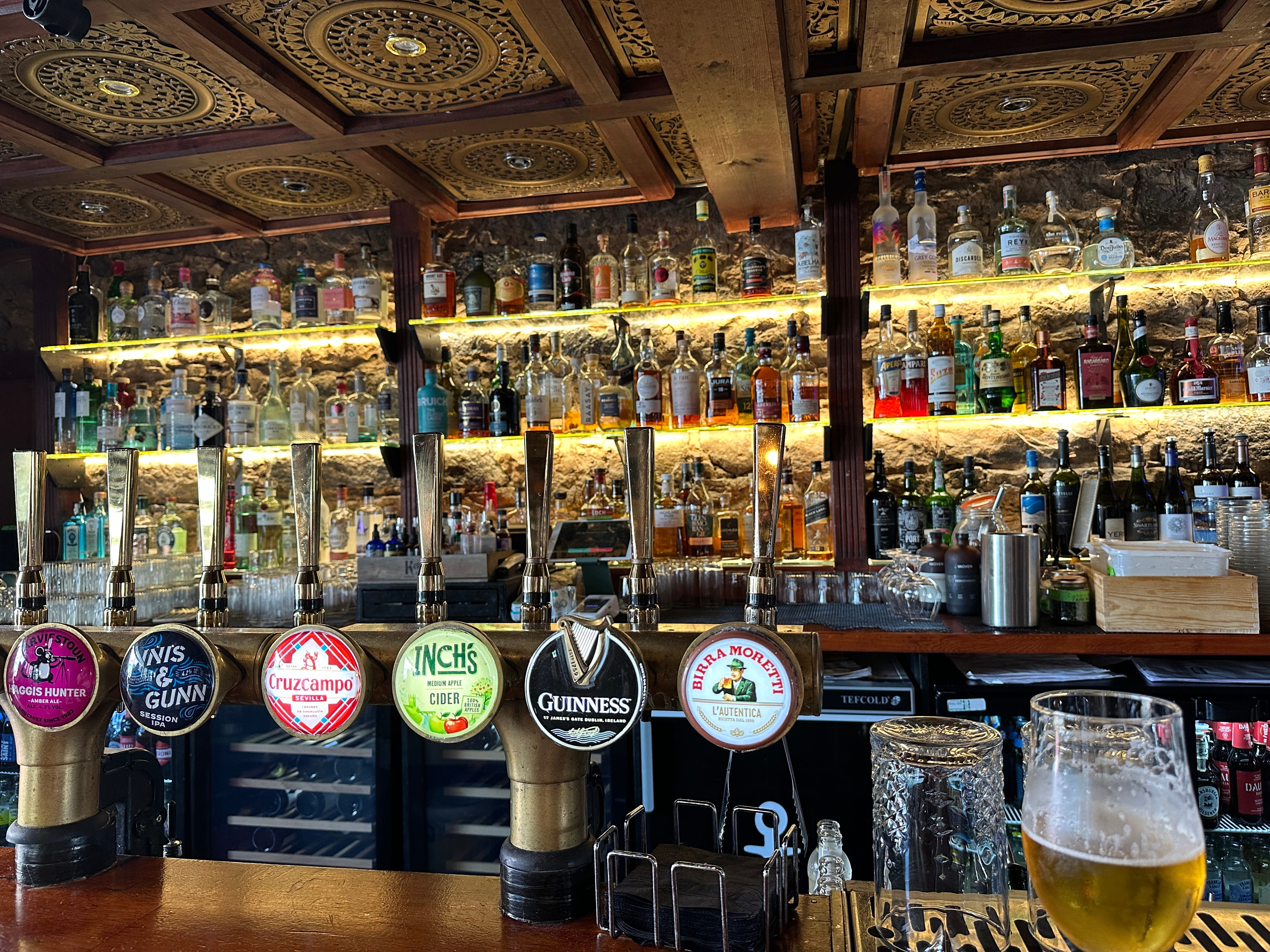
Which brings me to the United States. I’ll be the first to say that no one in my city of Portland, Oregon can complain about our bar food. We have consistently great classics like wings, burgers, sandwiches, fries, and tots, as well as pizza, salads, and exceptional vegetarian and vegan options. You’ll find it at our dives and cocktail bars alike. And when a spot doesn’t serve food, there’s usually a good food cart or pod nearby. But most of the US does not hold their bar food standards to the heights that Portland does. And even still, there is always room for improvement and variety. There are plenty of bars here that only serve mediocre food or none at all. We all have a watering hole like that
In my neighborhood rotation of haunts, there are at least three spots offer bad or no food. You know the drill, you’re a little pickled, and you either skip eating entirely, or you eat simply because having some food is better than no food. Either way, you don’t leave satisfied. But imagine walking into that same place — neighborhood bar fully intact with cold high life bottles and PBR cans, a local IPA on tap, hefty pours of whiskey, and $5 high balls — and then being greeted by a menu full of Naans and Curries? Or Pad Thai, Kao Soi, and Fried Rice? Shit, why stop there?
I’d like to see tacos, burritos, and sopapillas surface on menus across town. Imagine! Legit street tacos discreetly appearing at dive bars around town. What could be better than a drinker’s bar that suddenly has an inconspicuous menu filled with century old recipes passed down from someone’s Abuelita?
I want to wander into this achievable dream of the spice-dive — a world of cheap drinks and far-flung flavors. I want to be handed my 4th pint as my wandering eye catches a glimpse of a never seen menu full of flavors from a world I know little about.
The Desi Pub is a beautiful thing that was born out of deep-seated racism and segregation in Britain. Could the spice-dive (this is the unofficial name until someone comes up with something better) spring from the current era of US ultranationalism and gross overreach from ICE? Instead of denying life here, what if we provided one more small opportunity to make one? Why not lower the barrier of entry to starting a small business, one that can provide a steady income, and help someone achieve the American Dream? In return, unused spaces and under-utilized amenities are given a new life, existing establishments receive a secondary dimension that help keep the lights on, and patrons get better variety and more reasons to stay longer.
Let’s get on with it already and match two things that have always belonged together: cheap drinks and legitimate street food. Bring the concept of Thai & Desi Pubs to America! And of course, fuck ICE.
A cold ale and a spicy curry? I'm in. Bring on the spice dives! And yeah, fuck ICE!
Love the idea. Have you visited Erin Rose in New Orleans? Fantastic dive bar that has a teenie food window in the back run by Killer PoBoys, which make insanely delicious sandwiches. It is the best.